

What is Titanium Tube? Benefits, Types and Applications
作者:kangbote 时间:2026-04-21 13:50:50
Titanium tube is a type of pipe that is used in a wide variety of industrial applications. It is approximately 40% lighter than steel and is extremely resistant to corrosion. In 2026, this hollow, cylindrical tube made of titanium or titanium alloys will play a key role in key industries such as aerospace, medical, chemical, and marine engineering.
What is Titanium Tube? Definition
Titanium pipes is a hollow cylindrical product made from titanium and titanium alloys by specialized processes. Customized titanium tubes sizes, thicknesses and lengths are available to meet different industrial needs.
As one of the important processing forms of titanium raw materials, titanium tube has the core qualities of titanium metal, and at the same time, by virtue of its hollow structure, it becomes an ideal choice for fluid transportation and heat exchange scenarios, and it is one of the core components for realizing high-efficiency transportation and heat exchange.
Core Advantages of Titanium Tube
Compared to traditional tubing, the advantages of titanium tube focus on five major aspects: strength, weight, corrosion resistance, high temperature resistance and biocompatibility, each of which corresponds to the core needs of key industries.
High Strength - Light Weight
The density of titanium is only 4.5g/cm³, while the density of stainless steel is 7.7-8g/cm³. titanium tubes is 40%-42% lighter than stainless steel tubing, and titanium tubes is even lighter than ordinary steel tubing.
In weight-sensitive areas such as aerospace and automotive, every kilogram of weight lost can significantly improve fuel efficiency or operational performance. Lightweight titanium tube is also easier to handle and install during installation.
Strong corrosion resistance
The corrosion resistance of titanium tubes is one of its core strengths, far exceeding that of stainless steel tubing. titanium tubes can effectively resist erosion by seawater, marine atmosphere, chlorine-containing solutions, all kinds of acids and alkalis, as well as oxidizing, reducing and other complex working conditions. In the chlorine-containing environment, stainless steel pipe is prone to pitting and stress corrosion cracking, while titanium pipe can perfectly avoid this problem.
High Temperature Resistance
Unlike many metal materials, titanium can maintain stable mechanical properties at high temperatures and is not easy to soften or deform.
Some titanium alloys can operate continuously at temperatures as high as 600°C (1112°F), while the upper limit of the applicable temperature of ordinary industrial pure titanium can be up to 350°C. For high-temperature conditions, high-temperature-resistant titanium alloys are required, which can withstand temperatures up to 550°C or more.
Good biocompatibility
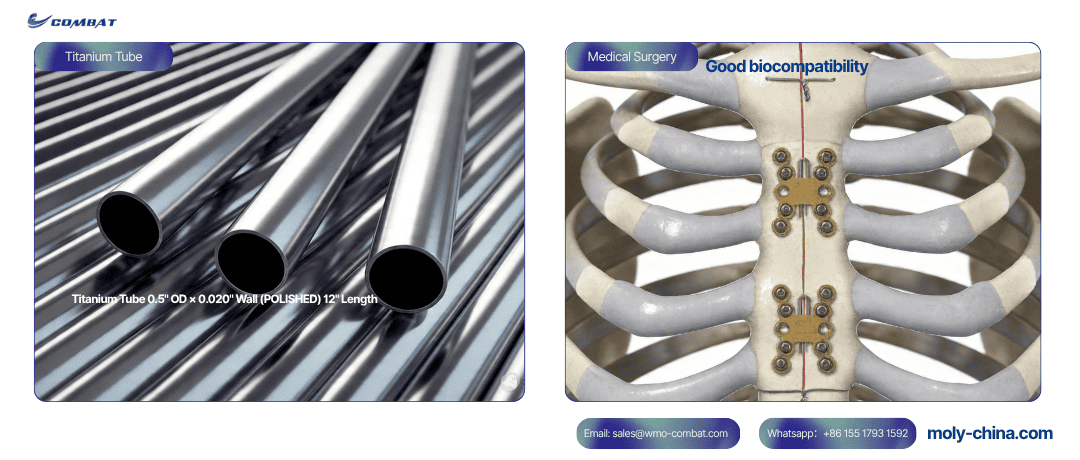
Titanium is a metal with excellent biocompatibility, in contact with human tissue, will not produce allergies, rejection and other adverse reactions, and will not corrode, but also with the human skeleton, tissue fusion.
At the same time, titanium is non-toxic and non-magnetic and will not interfere with the normal operation of medical equipment. This characteristic makes titanium tubes the material of choice in the medical field.
Difference Between Titanium tube and Steel Tube
Compared to conventional steel, stainless steel and other alloy tubes, titanium tubes are strong, lightweight and corrosion-resistant. Traditional steel tubing is still strong, but heavy and prone to corrosion; stainless steel tubing has limited corrosion resistance and is easily damaged in harsh environments.
|
Property |
Titanium Tubes |
Stainless Steel Tubes |
|
Density (g/cm2) |
4.5 |
7.7-8.0 |
|
Tensile Strength (MPa) |
345-1240 |
515-827 |
|
Corrosion Resistance |
Excellent |
Good to Excellent |
|
Max ServiceTemperature (°C) |
600 |
800 |
|
Biocompatibility |
Excellent |
Fair |
|
Relative Cost |
High |
Medium |
Common Types of Titanium Tube
The difference in performance of titanium tubes stems mainly from the different grades of titanium alloy used in it. Below are the four most common grades of titanium tubes, corresponding to different industry needs.
Grade 2 titanium (industrially pure titanium)
Grade 2 titanium is industrially pure titanium with no other alloying elements added, and is one of the most commonly used grades of titanium tubes. Its core strengths are excellent corrosion resistance, good moldability and moderate strength at a relatively low cost and low processing difficulty.
Since it is not necessary to take on high strength requirements, pure titanium tubes is widely used in industrial scenarios that do not require high strength, such as heat exchangers, condensers, chemical processing equipment, and marine components.
Grade 5 Titanium (Ti-6Al-4V)
Grade 5 titanium is an alpha-beta type titanium alloy and is the most widely used grade of titanium alloy - more than 50% of global titanium alloy usage is accounted for by grade 5 titanium.
Grade 5 titanium pipe has excellent strength, weldability, formability and corrosion resistance, with thermal properties and stiffness comparable to commercial titanium, and strength up to 900MPa or more, making it suitable for structural components.
Grade 9 Titanium (Ti-3Al-2.5V)
Grade 9 titanium is also an alpha-beta type titanium alloy, with core advantages of good ductility, high strength, excellent corrosion resistance, as well as cold working and welding, and excellent molding properties.
Grade 9 titanium pipe is used in the aerospace field for the manufacture of components such as aircraft hydraulic systems, aircraft honeycomb panels, etc. The applications of titanium tubes also cover the fields of medicine, dentistry, marine and sports, which makes it a more versatile grade of titanium tubes.
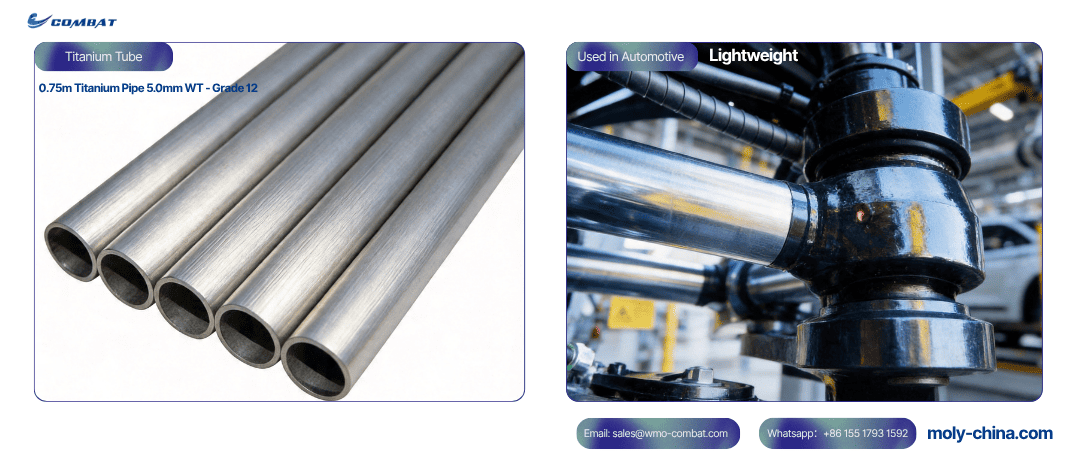
Grade 12 Titanium (Ti-0.3Mo-0.8Ni)
Grade 12 titanium has two alloying elements, molybdenum and nickel, and its core strengths are corrosion resistance and creep resistance at high temperatures, excellent weldability, and strength comparable to that of No. 2 titanium.
Grade 12 titanium is used in high-temperature industrial processing, chemical equipment and other scenarios, especially suitable for equipment that needs to operate for a long time in a high-temperature, corrosive environment, which can effectively extend the service life of the equipment.
Precision Manufacturing of Titanium Tube
The excellent performance of titanium pipe depends not only on the grade of titanium alloy, but also on the precision manufacturing process and strict quality control.
Seamless titanium tubes
Seamless titanium pipes are mainly produced by extrusion or pilger milling process, without welding, with higher overall sealing and strength, and better dimensional accuracy.
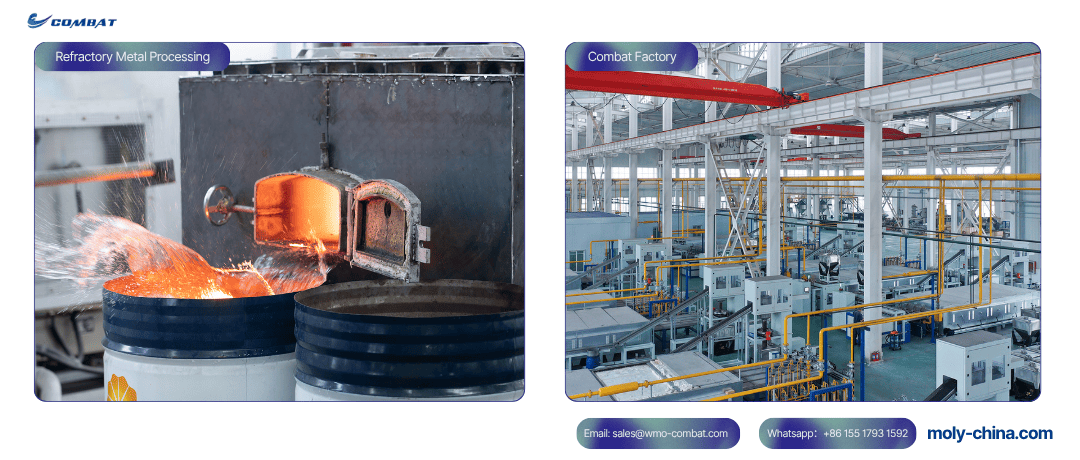
The production process involves multiple steps such as titanium sponge melting, ingot billeting, tilting and piercing, hot extrusion, etc. The vacuum self-consuming arc furnace melting temperature needs to be over 1700°C, and the melting should be repeated 2-3 times in order to eliminate segregation, while the electron beam cold-bed furnace is used for production of aerospace-grade titanium tubes, which can control the content of impurity oxygen to less than 0.12%.
COMBAT offers titanium tubes in different sizes, with outside diameters ranging from a few millimeters to hundreds of millimeters and wall thicknesses customized to requirements.
Welded titanium tubes
Welded titanium tubes are mainly produced by laser or TIG (Tungsten Inert Gas Welding) processes and are suitable for the production of thin-walled titanium tubes down to a wall thickness of 0.5 mm.
The production process includes titanium strip coil molding, argon gas protection welding, cold rolling wall reduction, intermediate annealing and other processes, the intermediate annealing temperature needs to be controlled at 650-750 ℃, in order to eliminate work hardening.
For example, the outer sleeve of minimally invasive surgical instruments and injection needle tubes can be as low as 0.5mm titanium tube OD.
Strict quality control
Titanium tube quality control is particularly stringent and relies heavily on a variety of non-destructive testing (NDT) methods to ensure quality.
Eddy current testing is a commonly used method for titanium tubes, which can detect defects as small as 0.1mm, ensuring that the tubing is free of cracks, porosity, etc. For titanium tubes used in aerospace hydraulic systems, 100% ultrasonic testing is conducted in accordance with AMS 4928 standards, eliminating any potential defects.
In addition, wall thickness deviation will be monitored by laser calibrator to ensure dimensional accuracy, industrial tubes need to be hydrostatic, flaring and other performance tests in accordance with GB/T 3625 standards, the surface will be removed by pickling (using a mixture of HF+HNO₃, the concentration of which is controlled at 5%-10%) to remove oxidized skin, and some of the high-end products will be polished so that the roughness Ra ≤ 0.2μm.
Titanium Tube in Industrial Applications
Aerospace and Defense
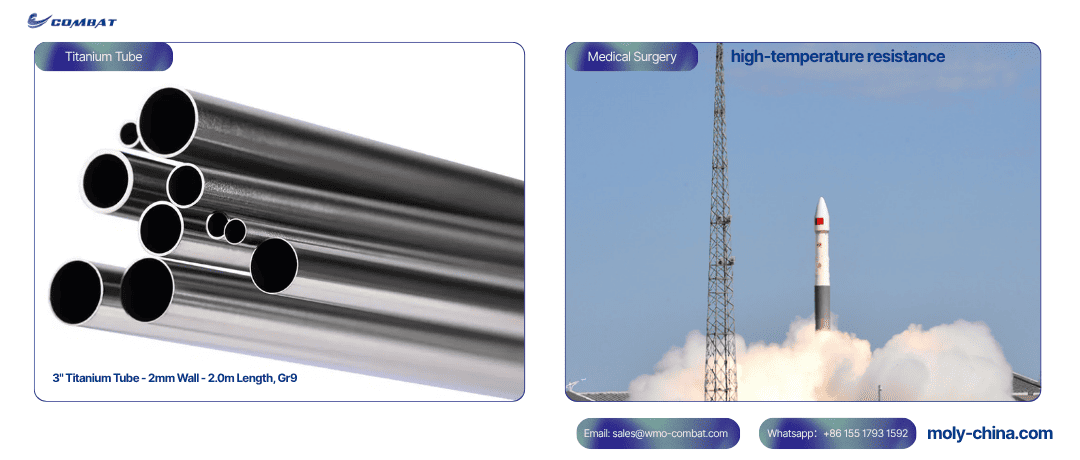
In aircraft manufacturing, titanium tube is mainly used in hydraulic systems (mainly grade 9 titanium, utilizing the high strength and fatigue resistance of titanium tubes), heat exchangers and compressor components of jet engines (utilizing its high-temperature resistance), as well as fuselage structural components, landing gear components and so on.
The Boeing 787 Dreamliner uses grade 5 titanium (Ti-6Al-4V) tubing for the landing gear, which reduces weight by 25% compared to conventional steel tubing and dramatically improves fuel efficiency;
SpaceX's Starship uses grade 9 titanium pipes for cryogenic liquid oxygen delivery piping, which is suitable for the extreme environment of space.
Marine & Offshore
In the marine environment, titanium tube is used in underwater equipment, ship piping systems, seawater cooling systems, offshore platform equipment, etc., which can withstand high pressure underwater, but also resist seawater corrosion, to ensure the long-term stable operation of equipment.
In the seawater cooling system, the grade 2 titanium seamless tube (such as Φ19×0.9mm specification) is often used as the heat exchanger tube bundle, with the grade 2 titanium plate as the equipment shell, which can realize the goal of stable operation for more than 20 years, and solve the problem of long-term corrosion.
Automobile industry
The demand for titanium tubes in the automotive industry mainly focuses on two aspects, lightweight and high temperature resistance, especially in the racing field, where the advantages of titanium tubes are more prominent.
In general commercial vehicles, titanium tubes can be used in engine components, exhaust systems, using its high temperature resistance, to withstand the high temperature of the engine and exhaust system, while the lightweight features can enhance fuel efficiency; in the field of racing, lightweight titanium tubes can help the vehicle to speed up quickly, to enhance the performance of the competition.
Chemical & Industrial
Titanium tubes in the chemical industry, including heat exchangers, condensers, chemical transportation piping, etc., of which grade 2 titanium is suitable for general corrosive environments, while grade 12 titanium pipe is suitable for high-temperature corrosive conditions, which can effectively improve the operational efficiency of the equipment and reduce maintenance costs. In addition, titanium tube has a smooth inner and outer wall and low fluid resistance, which further enhances the efficiency of fluid transportation, and is especially suitable for precision fluid transportation scenarios.
Medical Technology
Titanium pipes has become a core material for high-end medical devices and implants. titanium tube is used in minimally invasive surgical instruments (mainly 23-gauge titanium, MRI-compatible), spinal fusion implants, dental implants, orthopedic rods, cardiovascular devices, and more.
Stryker's use of custom-drawn titanium tubes for spinal fusion implants has resulted in an 18% increase in surgical success rates, exemplifying the benefits of titanium tubes in the medical field.
Key Considerations for Purchasing Titanium Tube
The quality of titanium tube has a direct impact on the operational safety and service life of the equipment, so the following four factors should be emphasized when purchasing titanium tubes. As a professional manufacturer of titanium tubes, COMBAT provides customers with compliant and reliable titanium tubes products.
Quality standards and certifications
When purchasing titanium tubes, the first thing to do is to make sure that the product complies with the relevant international quality standards.
Common standards for titanium tubes include ASTM (American Society for Testing and Materials, e.g. ASTM B338 for condenser titanium tubes), AMS (Aerospace Material Specification, e.g. AMS 4928 for aerospace titanium tubes), and China's GB/T series of standards, with attention paid to material certificates (MTCs) to ensure that the product's chemical composition and mechanical properties meet the requirements.
Titanium tube manufacturer COMBAT has been in the industry for many years, specializing in supplying titanium tubes, and can provide a full set of compliance certification documents to supply high quality titanium tubes.
Titanium Supplier's Reputation and Experience
The manufacturing process of titanium tubes is complex, and the technical level and production experience of titanium tubes manufacturers directly determine the stability of product quality.
When purchasing, priority should be given to refractory metal industry suppliers with good reputation in the industry and many years of production experience, and the credibility of the suppliers can be assessed by checking customer evaluations, case studies, industry certifications, etc. As a titanium tube manufacturer with excellent reputation and exporting to many countries (the United States, Australia, Canada, India, etc.), COMBAT is a reliable choice for purchasing titanium tubes.
Titanium Tube Customization Capability
The demand for titanium tubes varies greatly from industry to industry and from equipment to equipment, so the customization ability of the supplier is crucial.
High-quality suppliers should be able to provide a variety of customization services, including titanium alloy grade type (according to the scenario to adapt to grade 2, 5, 9, etc.), size and wall thickness customization, surface treatment and coating, etc. With strong customization capabilities and titanium tube processing technology, COMBAT can create customized titanium tubes, which can help to improve the operational efficiency of the equipment.
Titanium Tube Price and Delivery Time
The price of titanium tube is affected by a variety of factors, including titanium alloy grade, size, processing technology, market demand, etc. When purchasing, you need to look at the price rationally, and can not simply pursue the low price. High-quality suppliers should provide transparent pricing, no hidden costs, and have an efficient logistics system.
Conclusion: the future of titanium tubes
The advantages of titanium tubes are driving industries toward greater efficiency, safety, and sustainability. With the continuous upgrading of manufacturing processes and the popularization of the concept of sustainable production, the application scenarios of titanium tubes will be further expanded.
If you are looking for titanium tubes for aerospace, medical, marine or other projects, contact COMBAT to help you select the right type of titanium alloy and supply high-quality titanium tubes products.
FAQ about Titanium Tube
Q1: Is titanium tubes more expensive than steel tubing?
Yes, titanium tubes is generally more expensive than regular steel and stainless steel tubing, mainly due to the scarcity of titanium raw material and the complex manufacturing process. However, in the long run, titanium tubes has a longer service life and lower maintenance costs, which can effectively reduce overall operating costs, especially in harsh environments, and is far more cost-effective than traditional tubing.
Q2: Which type of titanium tubes is suitable for marine applications?
Marine applications prioritize the selection of corrosion-resistant grades, grade 2 titanium (TA2) is the most commonly used choice, cost-effective, excellent seawater corrosion resistance; if it involves high temperatures or more complex corrosive environments, marine engineering can also use TA10 titanium alloy composite pipe, both corrosion resistance and weldability.
Q3: How long is the service life of titanium tube?
The service life of titanium tubes depends on the application scenario and the use of the environment: in ordinary industrial environments, the service life of up to 15-20 years; in the ocean, chemical and other harsh environments, if properly maintained, the service life of more than 20 years; titanium tubes in the field of aerospace, after rigorous testing, the service life of titanium tubes to meet the needs of the equipment's full life cycle.
Q4: Can titanium tubes be welded?
Yes, most titanium tubes (e.g. Grade 5, Grade 9, Grade 12 titanium) have good welding performance and can be welded by laser welding, TIG welding and other processes. However, titanium tube welding needs to be carried out under inert gas protection to avoid being oxidized during the welding process.