

Tungsten Rods vs. Molybdenum Rods: Properties and Uses Comparison
作者:kangbote 时间:2026-04-24 16:01:01
Tungsten rods and molybdenum rods are both refractory metal materials with melting points higher than 1650°C. They are indispensable core materials for industrial production, advanced manufacturing and special fields.
Comparison of Material Properties
Physical tungsten rods and molybdenum rods properties are the most fundamental difference.
Melting point comparison
Tungsten rod melting point is at 3422℃, which is one of the materials with the highest melting point among the commonly used metals in the industry, and it is able to maintain its structural integrity in the ultra-high-temperature environment above 2000℃. Molybdenum rods melting point is at 2623°C, which is lower than tungsten rods, but also far higher than common metals.
Density Comparison
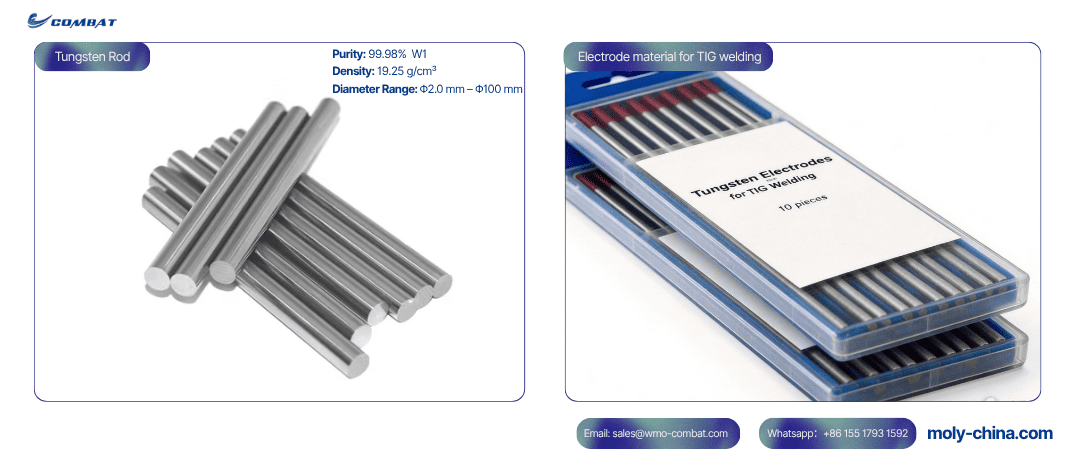
Tungsten rods density is 19.25 g/cm³, which is nearly twice the density of molybdenum rods. Tungsten rods weight are high and used in high weight and density application.
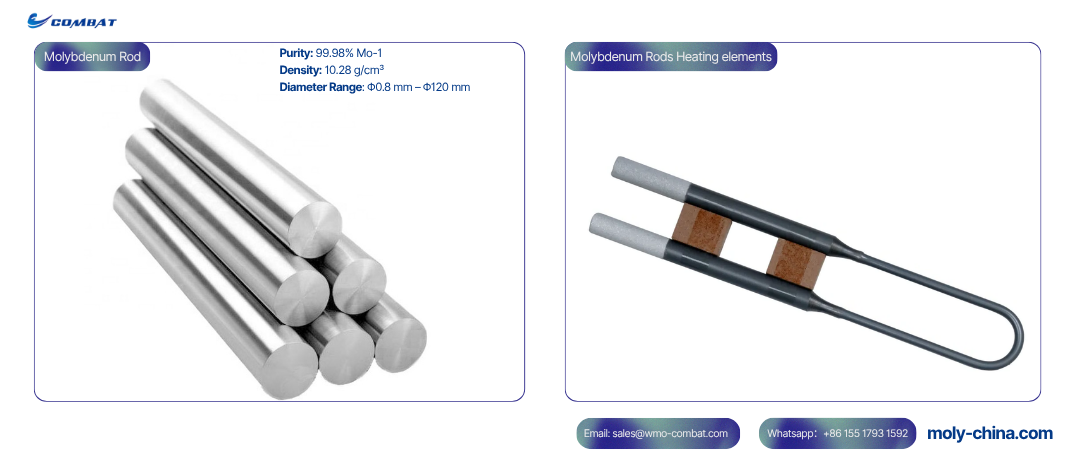
Molybdenum rods density is 10.28 g/cm³, which makes them ideal for high-temperature applications where weight is important and where strength and lightness are important.
Young's Modulus Comparison
Young's modulus reflects the stiffness of the material. Tungsten rods have a Young's modulus of 400-410 GPa, which is significantly higher than that of molybdenum rods, making them suitable for applications with high structural rigidity and large loads, such as high-end mechanical support parts.
The Young's modulus of molybdenum rods is 329-330 GPa. Although the stiffness of molybdenum rods is lower than that of tungsten rods, the processing difficulty is lower.
Comparison of recrystallization temperatures
The recrystallization temperature directly affects the structural stability of the material at high temperatures. The recrystallization temperature of tungsten rods is 1200-1500°C, which makes it difficult for grains to grow at high temperatures, and the structural stability is stronger.
The recrystallization temperature of molybdenum rods is 1000-1200℃, which is slightly lower than tungsten rods. In the long-term use of more than 1000℃, it is necessary to pay attention to the grain refinement treatment to avoid the performance decline.
| Performance Metric | Tungsten Rod | Molybdenum Rod |
| Density | ~19.3 g/cm³ | ~10.2 g/cm³ |
| Melting Point | 3422°C | 2623°C |
| Thermal Conductivity | 173 W/m·K | 138 W/m·K |
| Resistivity | 5.6 μΩ·cm | 5.2 μΩ·cm |
| Coefficient of Linear Expansion | 4.5 × 10⁻⁶ /K | 5.0 × 10⁻⁶ /K |
| Hardness (Rockwell) | 7–7.5 | 5–6 |
Chemical stability
Chemical stability of molybdenum rods
Molybdenum rods are highly resistant to corrosion and are not prone to corrosive reactions when exposed to common industrial chemicals such as acids, alkalis and salts. Molybdenum rods have outstanding antioxidant performance at high temperatures, maintaining structural integrity at high temperatures and are not easily oxidized.
Chemical stability of tungsten rods
Tungsten rods also have good corrosion resistance and can be stabilized in most chemical environments, but the high temperature oxidation resistance of tungsten rods is weaker than that of molybdenum rods.
High Temperature Tensile Strength Comparison
High-temperature tensile strength of molybdenum rods
At room temperature, the tensile strength of molybdenum rods is 600-700 MPa, which decreases as the temperature rises, dropping to 300-400 MPa at 1500°C. It is worth noting that doped molybdenum rods (e.g. TZM molybdenum alloys, i.e., titanium-zirconium-molybdenum alloys) have a significantly higher high-temperature performance, and at 1500°C they can still maintain a tensile strength of 500-550 MPa, far exceeding that of pure molybdenum rods. Tensile strength, far exceeding that of pure molybdenum rods, is the preferred choice for high-end high-temperature scenarios.
High-temperature tensile strength of tungsten rods
The tensile strength of tungsten rods at room temperature has an obvious advantage, reaching 900-1000MPa, far exceeding that of molybdenum rods, making them suitable for high load scenarios at room temperature. However, as the temperature rises, the tensile strength of tungsten rods decreases sharply. When the temperature reaches 1500℃, the tensile strength of tungsten rods is only 100-200MPa, which is only suitable for short-term ultra-high temperature scenarios.
Oxidation stability
Although molybdenum rods have better high-temperature oxidation resistance than tungsten rods, both need to be used in a protective atmosphere (e.g., inert gas, vacuum) at temperatures above 400°C in order to effectively avoid oxidative damage.
In contrast, molybdenum rods have more reliable stability in high-temperature oxidizing environments and are less prone to severe oxidation even when briefly exposed to air, while tungsten rods oxidize more rapidly when exposed to air at high temperatures, which can easily lead to surface damage.
Tungsten Rod vs. Molybdenum Rod: Price Comparison
Cost and availability are key considerations for large-scale industrial applications. The difference between tungsten rods and molybdenum rods in this regard has a direct impact on the scope of their application and popularity.
Molybdenum Rods Price
Molybdenum is relatively abundant and has a much higher availability than tungsten, molybdenum rods price for sale are lower and more suitable for large-scale industrial applications. Molybdenum rods are less difficult to process, easy to cut, forge and mold, and can be made into complex shaped components.
Tungsten Rods Price
Tungsten is a rare metal with limited reserves and low availability. High tungsten materials price results in tungsten rods being far more expensive than molybdenum rods, with a higher cost threshold. In addition, tungsten rods have high hardness and poor toughness, making them difficult to process and requiring specialized processing equipment and processes.
Industrial applications of tungsten and molybdenum rods
High-temperature furnace and vacuum industry
Pure tungsten rods in ultra-high temperature scenarios are still stable. Tungsten rods are used in the high-temperature furnace and vacuum industry for the manufacture of ultra-high-temperature heating elements (with operating temperatures of 2,000-2,800°C), vacuum furnace insulation screens, reflective panels, and core hot zone components for sapphire and monocrystalline silicon growth furnaces.
Molybdenum rods are suitable for medium and high temperature vacuum scenarios up to 1800°C.
Applications for molybdenum rods in the high-temperature furnace and vacuum industry : vacuum furnace heating elements, support brackets, load-bearing rods, and hot zone components for monocrystalline silicon and polycrystalline silicon growth furnaces and ceramic sintering furnaces.
Electronics and Semiconductor Industry
Applications of tungsten rods in the electronics and semiconductor industries include: anodes, cathodes and filaments for electron tubes and high power tubes, X-ray tube targets, as well as semiconductor sputtering targets, wafer heaters, and high voltage connector contacts. Applications for molybdenum rods in the electronics and semiconductor industries:electrodes, leads and gates for vacuum electronics, molybdenum-glass seals, wafer transfer rods, and precision structural components for etching and deposition equipment.
Welding and Electrode Discharge Machining (EDM) Industry
Tungsten rod is the core electrode material for TIG welding and plasma cutting. Tungsten rod is widely used in high-end welding scenarios, such as aerospace and automobile manufacturing, because of its high hardness, good abrasion resistance, resistance to high-temperature ablation and arc stabilization, and its ability to maintain the shape of the electrode during the high-temperature welding process and extend its service life.
Molybdenum rods have a lifespan about 37% longer than tungsten rods in the welding and EDM industry. Molybdenum rods can ensure machining accuracy, reduce electrode loss and improve machining efficiency. Molybdenum rod alloy materials are used in the machining of complex shaped precision parts.
Metallurgy and glass industry
Tungsten rods are mainly used in high-end metallurgical scenarios due to their high temperature resistance and hardness. Applications of tungsten rods in the metallurgical and glass industries: electrodes for the smelting of rare earths and precious metals, high-temperature stirring paddles, and key components of glass furnaces.
Molybdenum rod prce is lower and easy to process. It has the property of not sticking to molten glass and non-ferrous metals, and can adapt to the medium and high temperature corrosive environment of metallurgy and glass production. Applications for molybdenum rods in the metallurgical and glass industries: stirring bars for float glass tin baths, electrodes for molten glass, and electrodes for rare earth smelting.
Aerospace Industry
Tungsten rods for aerospace applications include: rocket nozzles, high temperature engine components, and high density counterweights. Tungsten rods are able to withstand ultra-high temperatures and extreme loads, and have high density and hardness.
Molybdenum rods for aerospace applications include: gas turbine blades, high-temperature missile connectors, and radiation-resistant components for the nuclear industry. Molybdenum rods are lightweight and high temperature resistant, enabling them to reduce equipment weight while maintaining structural strength, improving the range and maneuverability of aerospace equipment.
Tungsten vs Molybdenum rods: How to choose?
When to choose tungsten rods?
Tungsten rods are preferred when the application scenario meets the following conditions:
- the working temperature exceeds 1800℃, requiring ultra-high temperature stability, such as ultra-high temperature heating elements, rocket nozzles, etc.
- high requirements on material stiffness and density, and need to withstand high loads, such as high-end mechanical support, high-density counterweights, etc.
- the working environment for the vacuum or inert gas, can avoid oxidation, such as the core components of the vacuum furnace, X-ray tube targets, etc..
- Insensitive to cost. Tungsten rods are expensive. If you are looking for performance, you can buy tungsten rods in bulk.
When to choose molybdenum rods?
Molybdenum rods are preferred when the application scenario meets the following conditions:
- the working temperature is between 1000-1800℃, long-term high-temperature stability is required, such as medium and high-temperature vacuum furnace components, chemical reactors, etc.
- cost-sensitive, large-scale applications or complex shapes, such as glass production equipment, welding electrodes, etc.
- working environment there is a risk of oxidation, the need for better high-temperature oxidation resistance, such as chemical processing, food manufacturing equipment.
- Requirements on the weight of the material, need to take into account the strength and lightweight, such as aerospace lightweight components, wafer transfer rods.
Reliable Tungsten and Molybdenum Supplier — COMBAT
Choose a professional and reliable tungsten and molybdenum manufacturer, COMBAT tungsten and molybdenum manufacturer as a preferred partner in rare metal industry.
We use high-purity raw materials to refine and realize micron-level tolerance control of tungsten rod diameter and length to ensure excellent performance in critical applications such as high temperature, precision welding and electronics industry.
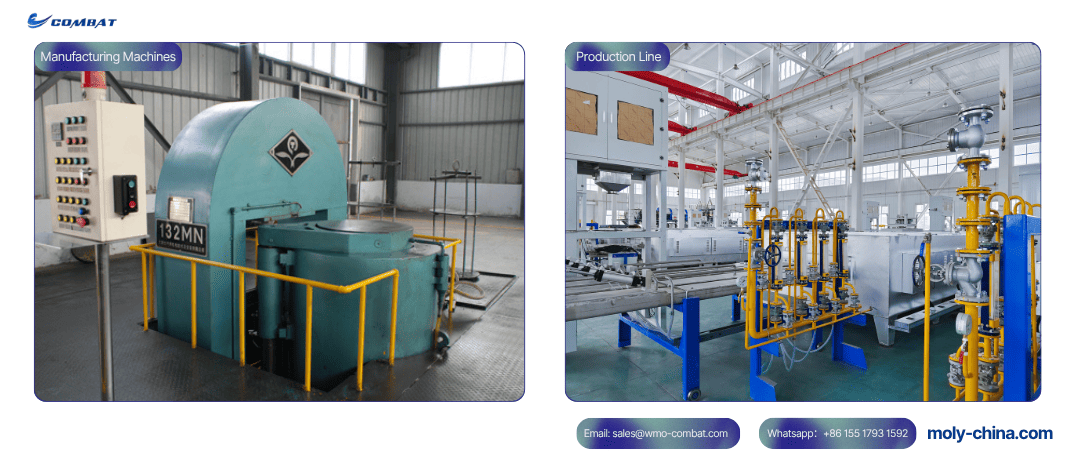
COMBAT is equipped with the leading automated production line in China, which can produce tungsten rods, molybdenum rods and all kinds of tungsten and molybdenum products in bulk, which can provide stable supply of tungsten and molybdenum and precise control of product precision.
|
Pure Tungsten Rods |
Pure Molybdenum Rods |
|
Diameter Range: Φ2.0 mm – Φ100 mm (Customized) |
Diameter Range: Φ0.8 mm – Φ120 mm (Customized) |
|
Length Range: 50 mm – 2000 mm |
Length Range: 50 mm – 1500 mm |
|
Diameter Tolerance: ±0.02 mm (for small diameters) – ±0.1 mm (Large diameters) |
Diameter Tolerance: ±0.03 mm (Small Diameters) – ±0.12 mm (Large Diameters) |
|
Length Tolerance: ±0.5 mm – ±2 mm |
Length Tolerance: ±0.5 mm – ±2 mm |
|
Surface Roughness: Ra ≤ 0.8 μm |
Surface Roughness: Ra ≤ 1.0 μm |
|
Surface Condition: Black, ground, or machined rods |
Surface Condition: Black, ground, or machined rods |