

How to Choose Tungsten Plate for Vacuum Furnace Heat Shield
作者:kangbote 时间:2026-06-30 15:59:30
In high-temperature vacuum furnaces, atmosphere sintering furnaces, sapphire crystal growth furnaces, and semiconductor heat treatment equipment, the heat shield is a key component in the core heat zone. It directly determines the temperature uniformity, energy consumption, process purity and the continuous operation life of the equipment. Compared with traditional heat insulation materials such as graphite and molybdenum, tungsten plate has become the first choice of heat shield material for ultra-high-temperature vacuum furnaces above 1800℃ due to its extreme high-temperature resistance.
In this article, we will systematically explain the selection method of tungsten plate for vacuum furnace insulation screen to help you improve the stability and productivity of vacuum furnace operation.
Why is Tungsten Plate Suitable for Vacuum Furnace Insulation Screen?
Tungsten (W) is the refractory metal with the best overall performance in industrialized applications, and its various properties are highly suitable for ultra-high-temperature working conditions under vacuum and inert atmosphere, and it is also the core material for high-end vacuum furnace heat insulation screen.
- Extreme high temperature resistance.
The melting point of tungsten is as high as 3422℃, far exceeding that of molybdenum (2623℃), nickel-based alloys, titanium alloys and other metal materials. Under vacuum environment, tungsten plate can stably withstand long-term working temperature of 2400-2800℃, which perfectly covers all kinds of ultra-high-temperature heat treatment, crystal growth, powder sintering process needs.
- Excellent dimensional stability and creep resistance.
The coefficient of thermal expansion of tungsten is extremely low, so it is not easy to warp, sag, deform, creep and collapse under the thermal cycle of repeated temperature rise and fall. It can maintain the structural integrity of the heat insulation screen for a long time, guaranteeing the stability of the temperature field in the furnace and significantly reducing process fluctuations.
The high purity adaptability under vacuum condition is the core highlight of tungsten plate. Tungsten has a very low vapor pressure in a high-temperature vacuum environment, and can maintain a very low outgassing rate at a high temperature of 2100°C, without generating volatile pollutants. Different from graphite heat insulation screen, high purity tungsten plate has no carbon precipitation and no dust fall, which is fully suitable for high clean process such as semiconductor, aerospace alloy, high purity crystal, etc.
- Tungsten sheet has excellent thermal management capability.
The thermal conductivity of tungsten plate is better than steel and nickel-based alloy, which can quickly and evenly disperse the heat in the furnace and eliminate localized hot spots. When used with multi-layer heat insulation structure, it can reflect radiant heat efficiently and minimize heat loss, combining fast heat circulation with energy saving effect.
In addition, the polished and oxidized tungsten plate surface has a high emissivity, which can quickly export heat through radiant heat dissipation. Combined with multi-layer shielding structure, it can further improve the temperature control precision and operation efficiency of the hot zone of vacuum furnace.
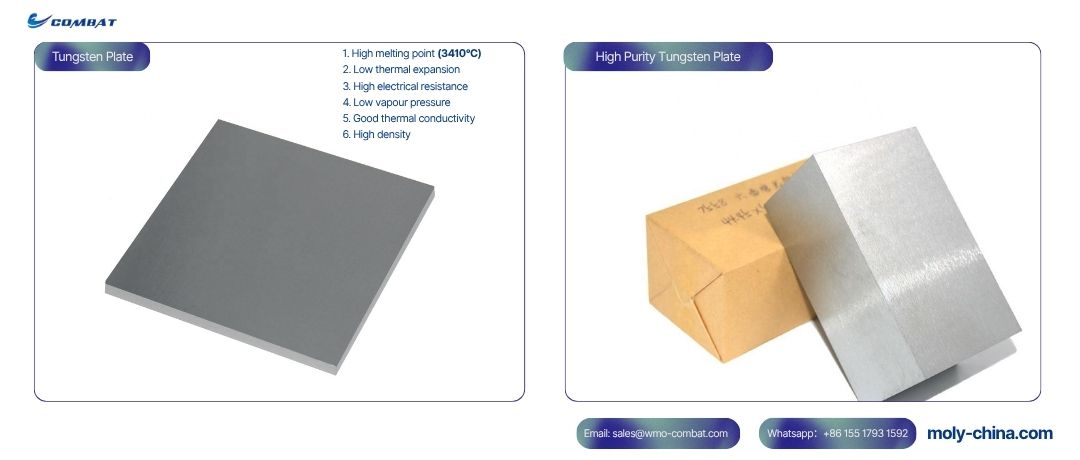
Selection of Tungsten Plate for Vacuum Furnace Heat Insulation Screen
Selection of tungsten insulation screen for vacuum furnace cannot be based on empirical judgment alone, but needs to be combined with the five core dimensions of furnace operating temperature, vacuum level, process purity, cycle frequency and structural use to accurately match the material parameters and eliminate over-performance or under-selection.
Matching temperature level and thermal stability
Temperature is the core indicator that distinguishes the applicable scenarios of tungsten and molybdenum plates, and it is also the first judgment basis for selection. Molybdenum heat insulation screen at 1600-1700 ℃ above will appear softening, creep, deformation failure, can not meet the needs of ultra-high temperature working conditions.
Pure tungsten plate can be stably applied in the high temperature hot zone of 1800℃-2400℃, which is the special material for the inner heat insulation screen of ultra-high temperature vacuum furnace. For more than 2400 ℃, high-frequency thermal cycling, long-term continuous operation of the extreme conditions, it is recommended to use tungsten rhenium alloy (W-Re) sheet.
Tungsten rhenium alloy can further improve the high-temperature creep resistance and low-temperature toughness, effective resistance to long-term high-temperature grain growth, embrittlement, significantly extend the service life of the heat shield, suitable for harsh continuous production conditions.
Material Purity and Grade
Most of the contamination and vacuum problems in vacuum furnace process failures originate from the insufficient purity of the insulation screen material. Impurities exacerbate high-temperature outgassing, material volatilization, and damage to the clean environment inside the furnace.
General high-temperature vacuum furnace insulation screen, must choose ≥ 99.95% high purity tungsten plate, can effectively control the outgassing rate and impurity precipitation, to protect the conventional heat treatment, sintering process stability.
For semiconductor processing, sapphire crystal growth, and ultra-high vacuum process, 99.98% ultra-high purity tungsten plate should be upgraded. Extreme purity can eliminate the contamination of the workpiece caused by the volatilization of trace impurities, and meet the requirements of high-precision, high-clean production.
When selecting tungsten plates, it is necessary to strictly distinguish between pure tungsten and tungsten alloy plates. No special toughness, creep resistance needs of conventional heat insulation screen, pure tungsten plate is the most cost-effective; high-frequency thermal cycling, vulnerable to stress impact conditions, give priority to tungsten rhenium alloy plate.
Thickness, size and surface technology
The thickness of tungsten plate directly affects the strength of thermal insulation structure, thermal inertia, temperature rise and fall speed and thermal insulation effect, different locations need to match the exclusive thickness specifications.
For the inner layer of multi-layer heat insulation screen assembly, it is recommended to use 0.1-3mm thin high purity tungsten plate. With small thermal mass and fast thermal response, the thin plate can support rapid temperature rise and fall of the equipment, shorten the production cycle, and be suitable for high-frequency processing conditions.
For load-bearing support, crucible base, and structural heat-insulating parts of the furnace body, tungsten plates 3-20mm and thicker are required. Thick plates have high structural strength and deformation resistance, and can withstand the weight of the workpiece and long-term thermal stress to avoid structural collapse.
Surface technology is also crucial. Polished mirror surface tungsten plate has high reflectivity and low emissivity, which can efficiently reflect the radiant heat in the furnace and reduce the heat loss. Meanwhile, the surface is dense and non-porous, so it is not easy to accumulate dust and impurities, which reduces the risk of contamination in the furnace from the source.
All tungsten plates for heat shielding screen need to adopt precision rolling process to ensure that the flatness and dimensional tolerance of the plate meets the standard, avoiding problems such as large assembly gaps and uneven heat deformation, etc., and guaranteeing the sealing of the multi-layer shielding structure and heat insulation stability.
Vacuum and process compatibility
Vacuum furnace insulation screen materials must have extremely low vapor pressure and low outgassing characteristics, which is the core condition to ensure the stable operation of high vacuum and ultra-high vacuum working conditions.
High-purity tungsten plate can maintain extremely low vapor pressure at a high temperature of 2000℃, and there will be no problems such as material volatilization and film precipitation, which is suitable for the operation of high-vacuum and ultra-high-vacuum equipments, and helps the equipments to quickly evacuate and maintain a stable vacuum degree.
Special attention should be paid to the fact that tungsten plates are strictly prohibited to be used at high temperatures in an oxygenated and humid air environment. When the temperature exceeds 500℃, tungsten will quickly oxidize to generate volatile oxides, causing sheet thinning, embrittlement and failure, so it must be strictly matched with vacuum or argon, hydrogen and other inert atmosphere working conditions.
Machining and assembly suitability
Tungsten material has obvious low-temperature brittleness characteristics, high hardness at room temperature, poor toughness, susceptible to impact cracking, which is the selection and assembly must focus on the problem.
In the structural design, the vacuum furnace tungsten heat insulation screen is commonly used riveted, lap joint structure, do not recommend on-site welding. Welding is prone to stress concentration, grain size problems, exacerbate plate embrittlement, shorten service life.
Selection needs to be combined with the equipment assembly method, giving priority to the selection of annealed tungsten plate. The annealing treatment can release the internal stress of the material, slightly improve the toughness, adapt to bending, riveting, cutting and other precision processing needs, reduce the probability of cracking during assembly and use.
Comparison of Materials for Thermal Barriers: Tungsten sheet vs. Molybdenum sheet vs. Graphite
The mainstream materials for thermal barriers in the hot zone of vacuum furnaces are categorized into tungsten sheet, molybdenum sheet and graphite, with great differences in performance, cost and working conditions. Accurate comparisons can be made to quickly lock in the optimal selection of materials, avoiding over-selection or under-selection.
- Molybdenum plate heat insulation screen: significant cost-effective advantage, excellent processing performance, better toughness, not easy to brittle crack. Suitable for medium-temperature vacuum furnaces below 1700 ℃, commonly used in the outer structure of multi-layer insulation screen, can be used with the inner layer of tungsten plate to form a composite insulation system, balancing performance and cost. The disadvantage is that the limit of high temperature resistance is low, and it is easy to soften and deform at high temperature, so it can't be used in ultra-high-temperature hot zone.
- Graphite heat insulation screen: low procurement cost, good heat preservation effect, high thermal inertia, suitable for low to medium temperature, low cleanliness requirements of conventional sintering and heat treatment processes. The core shortcoming is that it is easy to drop powder, precipitate carbon impurities, contaminate high-purity workpiece, and slow cooling speed, low thermal cycle efficiency, completely unsuitable for semiconductors, precision crystals and other high-end processes.
- Tungsten plate heat insulation screen: high temperature resistance, high cleanliness, creep resistance, low outgassing, is the only preferred choice for ultra-high temperature, ultra-high vacuum and high cleanliness process above 1800℃. Long-term stable operation, excellent temperature field uniformity, the only shortcomings are high procurement costs, low-temperature brittleness, the need for supporting professional structural design and use of specifications.
|
Material Type |
Maximum Operating Temperature |
Process Cleanliness |
Deformation / Creep Resistance |
Application Scenarios |
Cost Level |
|
Tungsten Plate |
2800°C |
Extremely High (Carbon-Free, No Contamination) |
Excellent |
Ultra-High Temperature, Ultra-High Vacuum, High-Purity Processes |
High |
|
Molybdenum Plate |
1700°C |
High |
Good |
Medium-High Temperature Vacuum Furnaces, Outer Heat Shield Layers |
Medium |
|
Graphite |
2200°C |
Low (Prone to Carbon Contamination) |
Average |
Conventional Medium-Low Temperature Sintering, Heat Treatment |
Low |
Tungsten Heat Shield Common Failure Modes and Selection Guide
Most of the problems of premature damage and substandard performance of tungsten heat shield in vacuum furnaces are not caused by material quality defects, but by wrong selection, improper structure or mismatch of working conditions. Mastering the cause of failure, you can avoid failure from the source and extend the service life of the equipment.
Core failure causes
High-temperature oxidation failure is the most common failure. Furnace leakage, incomplete vacuum extraction, and oxygen residue during the temperature rise and fall stage will lead to rapid oxidation of tungsten plate at a high temperature of 500℃ or above, generating volatile tungsten oxide. This ultimately results in thinning of the plate, loosening of the plate surface, failure of thermal insulation, and at the same time contamination of the workpiece in the furnace.
Low-temperature brittleness and thermal shock cracking problems are frequent. Tungsten material exists 200-400 ℃ tough and brittle transition temperature, low-temperature state by vibration, bumping, rapid temperature shock, very easy to produce micro-cracks. After a long period of thermal cycling, the micro-cracks will continue to expand, eventually leading to plate fracture and peeling.
Thermal cycle deformation and creep collapse should not be ignored. Unsupported single-layer structure, plate thickness is too thin, the assembly gap is unreasonable, will lead to long-term high-temperature operation of the plate by the thermal stress, sagging, warping, wrinkles, damage to the thermal insulation structure and temperature field uniformity.
Surface contamination leads to attenuation of heat insulation performance. Workpiece volatiles, furnace impurities deposited on the surface of the tungsten plate will change the emissivity and reflectivity of the plate surface, resulting in local hot spots, heat loss increases, directly reducing the overall efficiency of the heat insulation screen.
Selection and use of core taboos
It is strictly prohibited to choose tungsten plate with low purity below 99.95%. Low purity plate with high impurity content, high temperature gas discharge, vacuum is difficult to meet the standard, very easy to contaminate the high-purity workpiece, adapted to high-end technology will cause mass production loss.
Prohibit the selection of thin plates across the board. Structural support, load-bearing parts of the selection of thin plates, will quickly appear deformation collapse; non-high-temperature areas blindly choose thick plates, will increase thermal inertia, reduce production efficiency, resulting in cost waste.
Eliminate single-layer tungsten plate heat insulation design. Single-layer structure has poor thermal insulation effect, serious thermal stress concentration, high energy consumption and easy to deform. Must use multi-layer shielding structure, with spacing pads, to achieve efficient thermal insulation and stress dispersion.
Must not be used at high temperature under non-vacuum and non-inert atmosphere. Oxygen environment and high temperature operation is the core cause of tungsten plate failure, under any working condition, the gas tightness of the furnace body should be strictly guaranteed to avoid the risk of oxidation.
Efficient Improvement Program
Multi-layer composite heat insulation structure is adopted, with tungsten plates in the inner layer and molybdenum plates in the outer layer, taking into account the ultra-high-temperature resistance and cost advantages. Reasonable number of layers and spacing design to minimize heat radiation loss.
Strictly implement the process of furnace leakage inspection and oven degassing to completely eliminate the residual oxygen and water vapor in the furnace and prevent high temperature oxidation from the source. Regularly maintain the sealing structure of the furnace body to ensure the stability of the vacuum environment.
Match the material grade and thickness according to the working conditions, tungsten rhenium alloy plate is selected for high frequency thermal cycling conditions, and the structural parts are thickened to avoid creep, deformation, embrittlement and other problems.
Select Tungsten Plate according to Application
Different vacuum furnace process purpose, temperature range, clean requirements are very different, targeted selection in order to achieve optimal performance and cost-effective, the following is the industry's mainstream scenarios of standardized selection program.
- Ultra-high-temperature vacuum furnace core insulation screen (1800-2800℃): 99.95%and above high-purity annealed tungsten plate, thickness of 0.1-3mm, using multi-layer riveted shielding structure. The inner layer of full tungsten plate is high temperature resistant, and the outer layer is matched with molybdenum plate to reduce the cost, which is suitable for high temperature sintering, metal heat treatment and other core working conditions.
- Sapphire crystal/semiconductor vacuum process: 99.98%ultra-high purity mirror-polished tungsten plate must be used. The plate surface is free of impurities, pores, and low outgassing, which can strictly guarantee the ultra-clean environment in the furnace, avoiding crystal growth defects and semiconductor workpiece contamination.
- High-temperature sintering/annealing load-bearing platform: 3-20mm thick tungsten plateor tungsten rhenium alloy plate. Material creep resistance, deformation resistance, can withstand long-term workpiece load and high-temperature stress, suitable for batch, continuous production conditions.
- High-frequency thermal cycling vacuum furnace: prioritize low wall thickness, low heat capacity and high purity tungsten sheet. It can realize rapid temperature rise and fall to shorten the production cycle. Meanwhile, it is equipped with stress release structure to resist fatigue damage caused by repeated thermal cycling and prolong the service life.
Tungsten Plate Procurement and Engineering
The final use effect of tungsten plate insulation screen not only depends on the selection parameters, but also is closely related to the processing technology, quality inspection standards, and assembly program. The following are the engineering recommendations of senior manufacturers in the industry, which are suitable for procurement and equipment modification needs.
- Prioritize the use of tungsten plate products in line with ASTM B760 industry standards, and require manufacturers to provide a complete purity test report, density parameters, mechanical properties of the quality inspection certificate to ensure that the traceability of the material is controllable, the performance of the standard, and put an end to non-standard and inferior materials. l Provide complete equipment parameters before procurement.
- Provide complete equipment parameters before purchase, including maximum working temperature, vacuum level, thermal cycle frequency, furnace size, process cleanliness requirements. Accordingly, the manufacturer can customize the thickness, flatness, surface technology and assembly structure of the plate to achieve precise fit.
- Prefabricated riveted and lap joint structure is preferred for insulation screen assembly, eliminating on-site welding process. Professional prefabricated structure can effectively avoid welding stress, coarse grain, brittle cracking and other problems to ensure structural stability.
- For new projects or equipment upgrades, it is recommended to dock with material manufacturers in advance. Adopting “tungsten + molybdenum” composite hot zone design, under the premise of safeguarding the performance of ultra-high-temperature working conditions, we can reasonably control the overall procurement cost and realize the balance between performance and cost-effectiveness.
- For continuous production equipment, we can reserve spare parts of common specifications. As the production cycle of tungsten plate is long, stocking up in advance can avoid long-term downtime after equipment failure and ensure production continuity.
Conclusion
The core of tungsten plate selection for vacuum furnace insulation screen is based on working condition, parameters and structure, and reject blind selection and empiricism. Choosing the right tungsten plate parameters is only the foundation, but the stable and reliable process quality and delivery capability is the core of the long-term stable production of vacuum furnace.
As a professional manufacturer of tungsten plates, COMBAT is deeply engaged in the field of precision machining of refractory metals, and with the hardcore process strength and full chain supply chain guarantee, we can avoid the industry pain points such as selection errors, material defects, delivery delays, etc. for the global vacuum equipment enterprises. Our tungsten plates strictly control the whole process of precision production standards, and strictly follow the ASTM B760 industry standard. Relying on high-purity raw material purification, precision rolling, annealing stress relief, mirror polishing and other core processes, we can stably produce 99.95%, 99.98% ultra-high purity tungsten plates and tungsten rhenium alloy plates. We support multi-layer riveting, customized size tungsten sheet, and processing tungsten sheet with shaped structure. Contact COMBAT technology now, we provide one-on-one precise selection program.
Frequently Asked Questions
Q1: What is the best purity standard for tungsten plate for vacuum furnace heat shield?
Conventional high-temperature vacuum furnaces recommend ≥99.95% high-purity tungsten plates; for semiconductor, crystal growth, and ultra-high vacuum processes, it is recommended to use 99.98% ultra-high-purity tungsten plates, which can completely avoid the problem of outgassing of impurities and contamination of the workpiece.
Q2:Whether to choose tungsten plate or molybdenum plate for vacuum furnace insulation screen?
For medium-temperature working conditions below 1700℃ and the pursuit of high cost-effectiveness, molybdenum plate is preferred; for ultra-high temperature, high cleanliness and long-term continuous operation conditions above 1800℃, tungsten plate must be chosen. In the project, the composite structure of inner tungsten plate + outer molybdenum plate is often used to take into account the performance and cost.
Q3:How to avoid high temperature oxidation failure of tungsten heat insulation screen?
The core is to ensure that the furnace body is absolutely airtight, maintaining a high vacuum or inert atmosphere environment. Strict implementation of the leakage detection and baking process, elimination of oxygen and water vapor residue, and prohibition of high-temperature heating operations in an aerobic environment can avoid oxidation failure from the source.
Q4:What thickness of tungsten plate is suitable for multi-layer vacuum heat shield?
The inner layer of conventional multi-layer heat shield is suitable for 0.1-3mm high-purity polished tungsten sheet; for the parts that require load bearing and structural support, 3-20mm thicker tungsten sheet is used, which is precisely adjusted according to the size of the furnace body and the loading demand.
Q5: How long is the service life of tungsten heat insulation screen in vacuum furnace?
The service life depends on the temperature, cycle frequency, vacuum environment and selection accuracy. Under standardized selection, standard operation and maintenance conditions, the high-purity tungsten heat shield can run stably for several years; high-frequency over-temperature and air leakage conditions will significantly shorten the service life.