

Complete Guide to Tungsten Copper Alloy Ratios Selection
作者:kangbote 时间:2026-07-30 18:10:33
The ratio of tungsten to copper content directly determines the core properties of the material such as hardness, electrical conductivity, thermal conductivity, high temperature resistance and wear resistance. Even if the ratio deviation is small, it will directly affect the service life of the equipment and the effect of the project. This article will explain the logic of tungsten-copper alloy ratio selection in all directions to help engineers in various industries quickly match the optimal material solution.
What is Ratio of Tungsten Copper Alloy?
First of all, it needs to be clear that tungsten copper alloy is not a solid-solution alloy in the traditional sense, but a typical powder metallurgy pseudo-alloy (composite material).The miscibility of the two metals tungsten and copper is extremely low, and it cannot be fused into a single metal structure by smelting.
All tungsten copper materials on the market are prepared by filling pores with a porous tungsten skeleton as the substrate through a copper infiltration process.This special molding process makes the performance of tungsten-copper alloy completely depend on the ratio of the content of the two metals, which is what we often call the tungsten-copper ratio.
The tungsten-copper alloy ratio refers to the weight percentage of tungsten (W) and copper (Cu) in the material.The ratio of all standard grades in the industry follows the weight-to-weight statistics, and there is a conventional process tolerance of ±2% in the production process, which is within the normal range of compliance.
Industry general labeling rules
The labeling method of tungsten copper alloy is globally unified, and the common formats include WCu XX/YY, CuW XX/YY, and WXXCuYY.Regardless of the labeling form, the first number represents the tungsten content, and the second number represents the copper content.
The ratio of tungsten-copper alloy is concentrated between W50/Cu50 and W90/Cu10, which means that the tungsten content is 50%-90% and the copper content is 10%-50%.The ratio of this range can be adapted to most industrial and high-end precision projects.
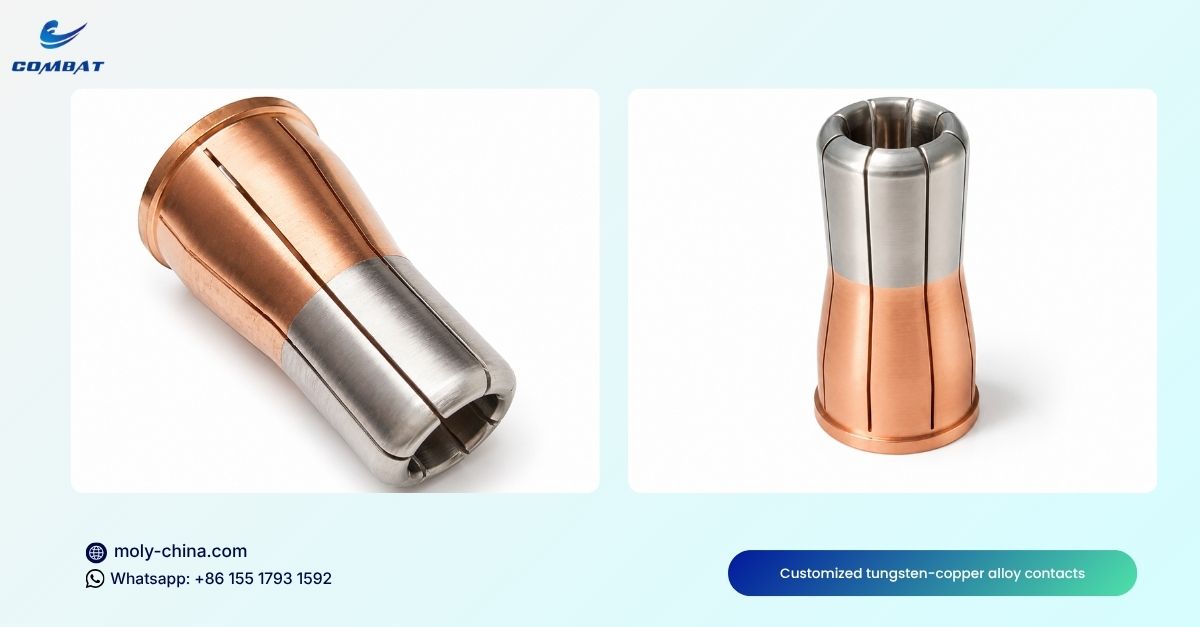
Why is Ratio Matter in Tungsten Copper Material Selection?
All the properties of tungsten-copper alloy are derived from the complementary characteristics of tungsten and copper metals.Tungsten has the advantages of high hardness, high density, high temperature resistance, and resistance to arc erosion, but it has poor electrical and thermal conductivity and high processing difficulty. Copper has excellent electrical and thermal conductivity and processability, but it has low hardness, high temperature resistance and poor wear resistance.
By adjusting the tungsten-copper ratio in tungsten copper manufacturer, the mechanical properties, thermal properties and electrical properties of the material can be accurately regulated to adapt to the core needs of different working conditions. Although material density, microstructure, and production technology will also affect the final use effect, the ratio is the core leading factor that determines the upper limit of tungsten copper material performance, and it is the primary basis for all material selection work.
Effect of Tungsten Copper Ratio on Material Properties
The elimination of tungsten content and copper content will cause tungsten copper materials to show completely opposite performance trends. Simply put: the higher the tungsten content, the more the material tends to have high temperature resistance and wear resistance mechanical properties; the higher the copper content, the more the material tends to have high electrical and thermal conductivity functional properties.
Advantages and disadvantages of high tungsten ratio (tungsten content 75%-90%)
The high tungsten ratio mainly includes W75/Cu25, W80/Cu20, W85/Cu15, W90/Cu10 and other high tungsten grades, focusing on the ultimate mechanical properties and high temperature stability.
In terms of mechanical properties, the high tungsten ratio material has a higher density, up to 16.75g/cm3, a hardness of up to 260HB, excellent tensile strength and outstanding deformation resistance. Under high-pressure and high-strength mechanical conditions, deformation and damage are not easy to occur.
Under high temperature conditions, the advantages of high tungsten ratio are more obvious. The coefficient of thermal expansion of the material is extremely low, there will be no softening or collapse at high temperatures, and the structure can be maintained for a long time. At the same time, it has strong resistance to arc erosion, wear resistance, and ablation resistance, and is suitable for extreme working conditions under heavy loads.
The corresponding performance shortcomings are also very obvious.As the tungsten content increases, the electrical and thermal conductivity of the material will continue to decrease.At the same time, high-tungsten materials have high hardness and high brittleness, which greatly increases the difficulty of machining, and the processing cost is higher. The overall cost performance is not suitable for ordinary light-load scenarios.
Advantages and disadvantages of high copper ratio (tungsten content 50%-70%)
The high copper ratio mainly includes W50/Cu50, W60/Cu40, W70/Cu30 and other grades, and the core advantages are concentrated in electrical, thermal and processing properties.
Such materials have a higher proportion of copper content and have excellent electrical and thermal conductivity.Among them, W50/Cu50 has a conductivity of up to 54% IACS, and its thermal conductivity far exceeds that of high tungsten ratio materials, which can quickly dissipate heat and reduce the operating temperature rise of the equipment.
At the same time, high-copper tungsten-copper alloy has better toughness and excellent processability, is not prone to chipping and cracking problems, can be processed into various precision and complex structures, has high processing efficiency, high pass rate of finished products, and effectively controls production and processing costs.
Its shortcomings are mainly reflected in the mechanical and high temperature properties.The hardness and density of the material are low, the wear resistance and arc erosion resistance are weak, and the coefficient of thermal expansion is high.Under heavy-duty conditions of high temperature, high voltage, and high current, it is prone to problems such as excessive wear and thermal deformation.
Comparison of Common Tungsten Copper Alloy Grades
|
Grade |
Tungsten (Wt%) |
Copper (Wt%) |
Key Characteristics |
Typical Applications |
|
W50Cu50 |
50 |
50 |
Highest conductivity, easiest machining |
Heat sinks, electrical components |
|
W60Cu40 |
60 |
40 |
Balanced thermal and electrical performance |
Electronic packaging |
|
W70Cu30 |
70 |
30 |
Good conductivity and wear resistance |
EDM electrodes, power electronics |
|
W75Cu25 |
75 |
25 |
Excellent balance of strength and conductivity |
Welding electrodes, heat sinks |
|
W80Cu20 |
80 |
20 |
High hardness and arc resistance |
High-voltage electrical contacts |
|
W85Cu15 |
85 |
15 |
Excellent wear resistance and dimensional stability |
Vacuum interrupters, aerospace |
|
W90Cu10 |
90 |
10 |
Maximum density, hardness, and heat resistance |
Defense, aerospace, extreme-duty electrical applications |
Choose the Best Tungsten Copper Alloy Ratio for Your Application
There is no absolutely universal "optimal tungsten-copper ratio", only the most suitable ratio suitable for working conditions.The requirements of the core working conditions of different industries vary greatly. The following is a combination of mainstream application scenarios to give accurate grade selection plans.
Match the tungsten-copper ratio interval according to demand
|
Priority / Scenario
|
Recommended Tungsten Content |
Typical Grades |
|
Conductivity & heat dissipation are top priority |
≤70% W |
W50/Cu50 – W70/Cu30 |
|
Wear resistance, arc erosion resistance & high-temperature stability are top priority |
≥75% W |
W75/Cu25 and above |
|
General-purpose / balanced performance (default choice) |
70% W |
W70/Cu30 (most widely used) |
|
Electronic packaging — low CTE + balanced thermal conductivity |
70% – 85% W |
W70/Cu30 – W85/Cu15 |
|
Extreme high-temperature, high-density, heavy-duty applications |
85% – 90% W |
W85/Cu15 – W90/Cu10 |
Resistance welding electrodes
Resistance welding electrodes have extremely high requirements for the balance of wear resistance and electrical conductivity of the material, and they need to take into account the heat dissipation efficiency and wear resistance to avoid frequent electrode replacement affecting production efficiency.
Light and medium-load welding conditions (convex welding, flash welding, butt welding): W70/Cu30 (RWMA Level 10) is preferred.The ratio has balanced performance, good conductivity and heat dissipation, and wear resistance to meet conventional production needs. It is the mainstream choice for general welding electrodes.
Medium and heavy-duty welding conditions (seam welding, electroforming mold, high-pressure welding): W75/Cu25 (RWMA level 11) is recommended.Higher hardness and structural strength, can withstand greater pressure and high-frequency working loads, and is suitable for medium and harsh working conditions.
Heavy-duty extreme working conditions (electric forging, high-pressure molds, high-strength welding): choose W80/Cu20 (RWMA level 12).It is the best ratio of hardness and wear resistance among conventional commercial grades, and can cope with long-term continuous work with high strength and high load.
EDM electrodes
The core trade-off points for EDM electrode selection are electrode loss rate, processing efficiency and workpiece surface quality. Different ratios are adapted to different processing materials and accuracy requirements.
Ordinary steel EDM: W70/Cu30 is selected by default.It has low loss, fast heat dissipation, strong processing stability, and takes into account processing efficiency and finished product accuracy. It is a general standard grade in the industry.
Processing of cemented carbide and high hardness materials: upgraded to W75/Cu25.The higher tungsten content greatly reduces electrode loss, avoids electrode deformation during processing, and ensures the machining accuracy of deep holes and complex structures.
High-precision mirror processing scenario: the copper content can be appropriately increased, and the tungsten-tungsten ratio can be selected.With better thermal conductivity and processing smoothness, the surface finish of the workpiece is improved and the processing lines are reduced.
High voltage electrical contacts and circuit breakers
High-voltage electrical tungsten copper contacts face long-term arc burning, current shock, and high-temperature cycle conditions. The core requirements are resistance to arc erosion, stable high-temperature structure, and the need to ensure basic electrical conductivity.
Conventional circuit breakers, SF6 switches, medium voltage contacts: suitable for W70/Cu30–W80/Cu20 interval ratio, taking into account arc resistance and conductivity, to meet the needs of long-term stable power-on work.
Heavy-duty and high-pressure, frequent closing and closing, and strong arc conditions: the high tungsten ratio of W80 and above is preferred.Relying on excellent anti-ablation and anti-wear properties, it effectively extends the service life of the contacts and reduces the probability of equipment failure.
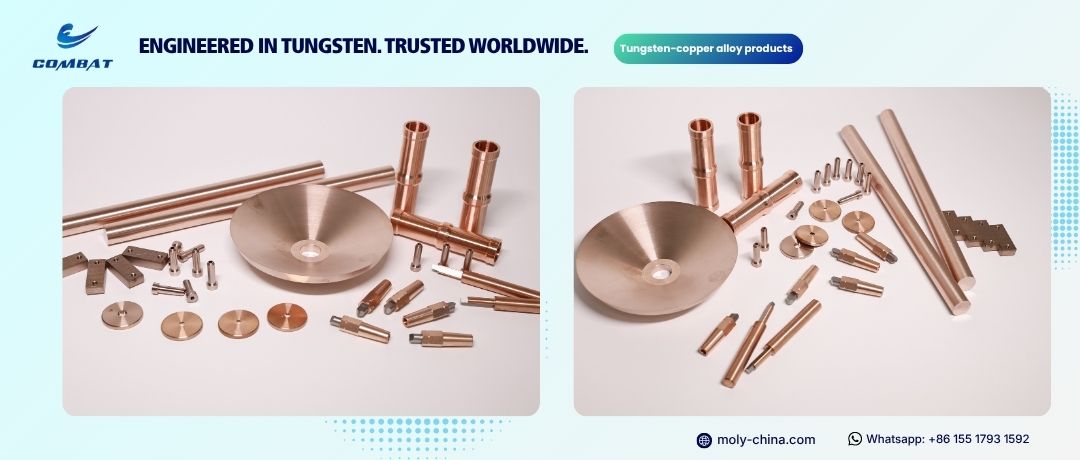
Heat Sink & Electronic Packaging
The core requirements of electronic heat sinks and semiconductor packaging substrates are matching coefficient of thermal expansion, uniform heat dissipation, stable structure, and avoiding warping, cracking, and stratification caused by thermal cycling.
The industry's general optimal range is W70/Cu30–W85/Cu15. The coefficient of thermal expansion of this ratio interval can accurately match semiconductor substrates such as silicon, ceramics, and gallium nitride, greatly reducing the risk of thermal mismatch.
At the same time, this new material retains excellent thermal conductivity, can quickly export the working heat of chips and components, and takes into account the heat dissipation efficiency and structural stability. It is the core material selection for high-end electronic packaging.
Aerospace and extreme high temperature conditions
Aerospace parts, high-temperature structural parts, and special thermal management parts have long been in high-temperature, high-pressure, and complex temperature environments, and have extremely high requirements for the high-temperature strength, density, and dimensional stability of materials.
W80/Cu20–W90/Cu10 high tungsten ratio materials are uniformly preferred for such scenarios.The ultra-high tungsten content allows the material to maintain structural strength and dimensional stability without softening and deformation in a high temperature environment above 1000℃.
At the same time, the material has high density, high radiation resistance, and high wear resistance, which can meet the extremely stringent service standards of aerospace and adapt to various special high-end working conditions.
Quick Selection Guide Chart of Wcu Alloy
|
Application |
Recommended WCu Grade |
Why It Works |
|
Resistance Welding Electrodes |
W75Cu25 / W80Cu20 |
Excellent wear resistance and electrical conductivity |
|
EDM Electrodes |
W70Cu30 |
Stable machining performance and good spark erosion resistance |
|
High-Voltage Electrical Contacts |
W80Cu20 / W85Cu15 |
Superior arc erosion resistance and long service life |
|
Heat Sinks & Electronic Packaging |
W70Cu30 / W75Cu25 |
High thermal conductivity with matched thermal expansion |
|
Vacuum Interrupter Contacts |
W80Cu20 / W85Cu15 |
Reliable switching performance under high-voltage conditions |
|
Aerospace Components |
W85Cu15 / W90Cu10 |
High density, dimensional stability, and heat resistance |
|
Military & Defense Applications |
W90Cu10 |
Maximum strength and resistance to extreme environments |
Common Mistakes When Choosing WCu Materials
Most of the failure problems of tungsten copper materials are not caused by the wrong choice of grade ratio, but by misunderstandings in the selection details.The following 8 types of high-frequency misunderstandings are the core issues that need to be avoided in engineering material selection.
Myth 1: Ignoring material density and porosity
Many engineers mistakenly think that as long as standard grades such as W80/Cu20 and W70/Cu30 are selected, the performance will be fully up to standard.In fact, the pore defects caused by the production process have a much greater negative impact on performance than the fine-tuning of the ratio.
Tiny residual pores will block current and heat conduction, greatly reducing the material's electrical conductivity, thermal conductivity and arc resistance.High-quality low-ratio dense materials have far better performance than high-ratio porous and inferior materials.
Solution: When selecting and purchasing, in addition to clarifying the ratio, suppliers must be required to provide the measured indicators of minimum density and maximum porosity, and priority should be given to fully dense copper infiltration process products.
Myth 2: Higher the tungsten content, the better the material
The high tungsten ratio only has advantages under wear-resistant and high-temperature-resistant conditions, and it is not a universal high-quality choice for all scenarios.The blind selection of ultra-high tungsten materials will lead to insufficient conductivity and heat dissipation, a sharp increase in processing difficulty, and a sharp increase in costs.
In high-frequency heat dissipation and precision machining scenarios, excessive tungsten content will cause heat accumulation and decrease processing efficiency, which will accelerate the failure of parts.
Solution: Adhere to the principle of “on-demand selection”, choose the lowest tungsten content ratio that can meet the needs of core working conditions, and balance performance and cost.
Myth 3: Ignoring the matching of the coefficient of thermal expansion
In the scenarios of electronic packaging and heat dissipation substrates, many people only pay attention to the thermal conductivity and ignore the matching of the coefficient of thermal expansion.The difference between the thermal expansion of the material and the substrate is too large, and warping, stratification, and cracking problems will occur in the hot and cold cycle.
Solution: Give priority to ensuring that the coefficient of thermal expansion matches silicon, ceramics and other substrates, and then fine-tune the ratio to optimize the thermal conductivity, and choose gradient tungsten copper materials if necessary.
Myth 4: Ignoring the impact of production technology on performance
For tungsten copper materials with the same ratio, the performance gap between the copper infiltration process and the ordinary pressing and sintering process of the finished product can reach 20%-30%.Process defects will lead to uneven distribution of copper, loose tungsten skeleton, and significant attenuation of performance.
Solution: Vacuum copper infiltration process products are preferred for key working conditions, and suppliers are required to provide process instructions and microstructure inspection reports.
Myth 5: Ignoring the processability of materials leads to uncontrolled production costs
The high tungsten ratio material has high hardness and high brittleness. The tool wears out quickly and easily during processing, and the processing equipment and technology requirements are extremely high.Failure to consider the processing performance in advance will lead to soaring processing costs and low yield in the later stage.
Solution: Medium-copper ratio materials are preferred for precision and complex parts, and the processing difficulty and production cost are reduced under the premise of meeting the performance.
Myth 7: The grade does not match the actual working condition load
Light-load grades are used in heavy-duty arc and high-pressure conditions, which will cause rapid ablation and wear failure; high-tungsten heavy-duty grades are used in high-frequency heat dissipation conditions, which will cause insufficient heat dissipation and excessive temperature.
Solution: Clarify the core parameters such as equipment current, pressure, operating frequency, and ambient temperature before selecting the type, and strictly match the corresponding grades according to the working conditions and loads.
Myth 8: Do not verify the performance report
The selection of the nominal parameters of the sample only ignores hidden indicators such as oxygen content, grain structure, and density, which are prone to problems such as substandard material properties and poor consistency, which affect the stability of the equipment.
Solution: Key projects must request a third-party inspection report to verify that the materials meet industry standards and ensure stable performance and compliance.
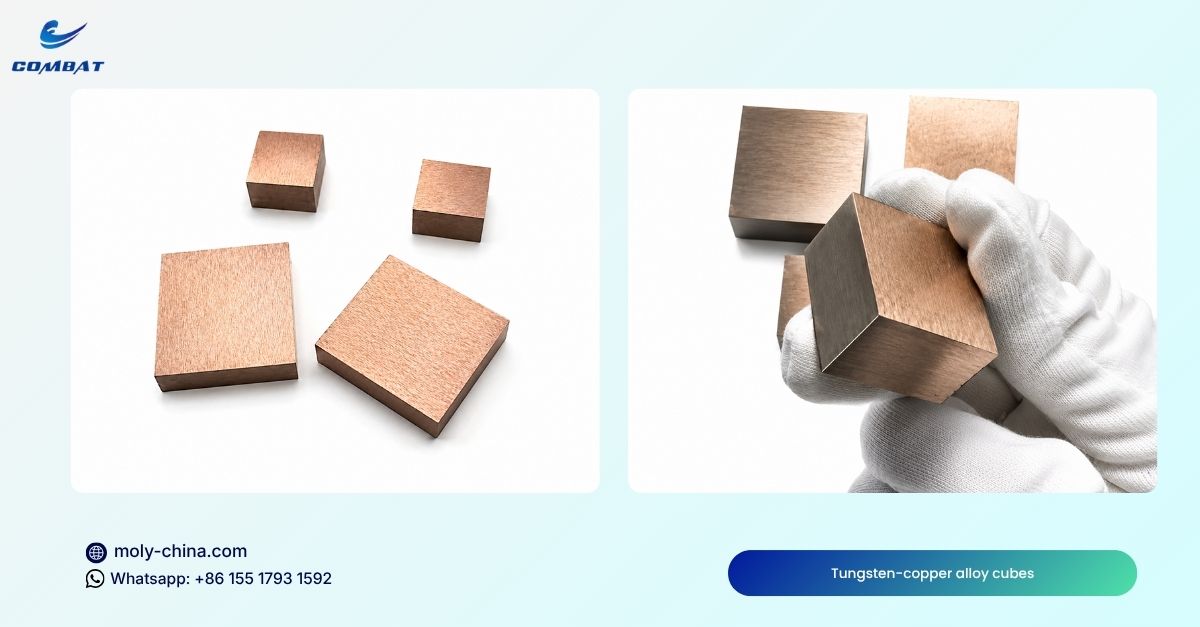
Customized Tungsten Copper Alloy Solution
In COMBAT's project experience, it involves the customization of precision tungsten copper plates for electronic packaging and special tungsten copper electrodes.
Relying on advanced copper infiltration and sintering technology, the tungsten-copper alloy ratio can be finely adjusted from 5% to 95% tungsten content, breaking through the limitations of commercial standard grades, and accurately customizing the exclusive performance ratio.
At the same time, by adding trace amounts of nickel, iron, phosphorus and other elements, the sintering performance and deoxygenation effect of the material can be optimized, and the conductivity and structural stability of the material can be further improved.
In addition to the customization of the ratio, it can also realize the full-dimensional customization of material density, porosity, micro-grain size, shape structure, precision size, surface polishing coating, etc., and directly deliver the finished parts to reduce the customer's secondary processing costs.
FAQ of Tungsten copper alloy ratio
Question: With the same tungsten-copper ratio, is there a difference in the performance of the copper infiltration process and the pressing and sintering process?
Answer: There is a difference.Under the same ratio, the copper-permeable material has fewer pores, uniform organization, stable performance and longer life.Ordinary sintered materials have many pores, large performance fluctuations, and lower reliability.
Question: Does the tungsten-copper ratio affect the welding splash and the surface quality of the workpiece?
Answer: It will affect.The high copper ratio dissipates heat quickly, the welding splash is small, and the surface quality of the workpiece is better.The high tungsten ratio is easy to accumulate heat, easy to splash and discoloration of the workpiece, and is not suitable for high-precision welding.
Question: Under the same working conditions, is there a big difference in the life of tungsten copper with customized ratios and standard ratios?
Answer: Reasonable customization of the ratio can increase the service life by 15%-40%, and it is suitable for short boards under special working conditions.However, blind customization and poor craftsmanship will lead to poor material performance and shortened life.
Question: Do you need to adjust the ratio of tungsten copper alloy under low temperature conditions?
Answer: It needs to be adjusted.The material of high tungsten (85%+) has high brittleness at low temperature and is easy to crack and chipping.Under low temperature and alternating hot and cold conditions, the ratio of 70%-80% medium tungsten is preferred, and the overall performance is more stable.
Question: What is the effect of the long-term high temperature oxidation resistance of tungsten copper alloy compared to tungsten copper alloy?
Answer: It has a great impact.High tungsten ratio, high temperature resistance and strong oxidation resistance, suitable for long-term high temperature operation.The high copper ratio is easy to oxidize, which can lead to increased resistance, poor heat dissipation, and rapid aging and failure of parts.
Conclusion
The core of tungsten-copper alloy ratio selection is to find the optimal balance based on the requirements of the project's working conditions. W70/Cu30 is the most versatile all-round grade. It increases the tungsten content under high load conditions and the copper content under high heat dissipation and conductivity conditions. At the same time, it avoids common misunderstandings in selection and takes into account the ratio selection and material quality.
If you need to obtain a tungsten-copper alloy ratio plan, you can contact us tungsten copper manufacturer to provide your project needs and customize an exclusive material selection solution for you.